DEMOCRACY AND FASCISM
Be sure you understand
- ideology
A fancy word for a collection of values and assumptions that tie together to represent an attitude about the world and how power works there, or how it should work there.
Everyone operates according to certain ideologies, even if they never consciously think about their values and beliefs and don't have names for them. - Liberal Democracy
Democracy is a form of government in which political power is vested in the people. Leaders and representatives are elected through competitive elections with a majority of voters deciding who will represent their interests in government. The form of democracy in the United States, Canada, and many other countries in which the individual freedom of each citizen is considered to be one of the most important rights the government is there to protect is called liberal democracy. The word "liberal" here betokens a commitment to the freedoms of individuals. - John Locke (1632 - 1704)
Inventor of liberal democracy. He argued that the government should largely focus on protecting the "natural rights" of the individual: Life, libery, and property - When women got the right to vote across Canada and the United States
Canada: 1918
U.S>: 1920
- left and right
A way of describing one or a couple of the ideological spectrums within democratic societies.
Attitudes toward how the government should be involved in wealth distribution, government spending, and government involvement in regulating businesses.
Attitudes toward social justice and government control of civil liberties.
In modern liberal democracies, the most common political ideologies are (left to right) socialism, liberalism (“centre”), and conservatism.
At the far left is communism and at the far right is fascism, two anti-democratic ideologies.
- progressive and conservative
Describing how open one is to new ways of being human vs how committed one is to supposedly traditional ways - socialist - liberal - conservative
The three most common political ideologies in liberal democracies. Socialist on the left, liberal in the centre, conservative on the right, - Authoritarian
A political ideology characterized by the rejection of pluralism and diverse civil liberties, and the use of strong central power to preserve the political status quo. - Fascism
An authoritarian and ultranationalist political ideology that was prominent in early-20th-century Europe, especially seen in the governments of Nazi Germany, Mussolini’s Italy (the origin of the term), and Franco’s Spain. In those cases, it tended to combine dictatorship (eg Hitler) with the oligarchical interests of a chosen “people” (eg the “Aryan” race – a subclass of white people), seen as the “legitimate” citizens of a nation-state (eg Germany).
Highlighted features of fascism:
- A CULT OF TRADITION
- ACTION FOR ACTION'S SAKE; ANALYSIS DELAYS ACTION; DISAGREEMENT IS TREASON; ANTI-INTELLECTUAL
- AGAINST DIVERSITY
- RISES OUT OF FRUSTRATED
ENTITLEMENT, HUMILIATION, AND ENVY
- POPULISM
- PRO-WAR; PACIFISM IS NEVER THE ANSWER
- MACHISMO
- Imperialism
A nation's drive to expand its territory or influence beyond its current borders. The desire to create an empire. (E.g., the Roman Empire, the British Empire, the Nazi Third Reich)
There are two kinds of people in the world: those who don't want to talk about politics at all and those who want to talk about politics too much. Lol. Whichever you are, I hope you will continue reading and open your mind to thinking more about some basic concepts that are used in discussing politics in countries like Canada.
Everyone has a political position, even if they don’t know what it is and consider themselves “apolitical.” Politics is about power. In particular the power of governments and authorities - and how you think it should be used. “I’m not political” is not really a meaningful statement. It just means you don’t want to acknowledge or think about or discuss your political place in the world. Or you may not even be conscious of what it is. This lesson is meant to be a step in the direction of making you more aware of your political values and how they impact you and other people. For some it may seem simple-minded and elementary; for others it will be largely new or framed in a different way that can give you something to think about, argue with, or memorize and then forget, as you see fit.
Ideology
Ideology is a fancy word for a collection of values and assumptions that tie together to represent an attitude about the world and how power works there, or how it should work there. Everyone operates according to certain ideologies, even if they never consciously think about their values and beliefs and don't have names for them.
Different national governments around the world operate according to different ideologies, and within those countries different political parties - if the country has multiple parties; some have only a single party that runs everything all the time - will have their own ideologies.
Canada is - at least in theory - a Liberal Democracy, so it operates on certain principles that are part of the ideology of liberal democracy.
Liberal Democracy
Democracy is a form of government in which political power is vested in the people. Leaders and representatives are elected through competitive elections with a majority of voters deciding who will represent their interests in government. The representatives then vote on public policy: the creation or alteration of laws, government programs and funding, etc. A liberal democracy focuses on protecting the individual freedom of each citizen and interfering with the citizen's freedom only as much as is necessary for the safety and freedom of other citizens. The use of the word "liberal" here should not be confused with Canada's Liberal Party, which takes its name and presumably its inspiration from the small-l principle of liberalism (protecting individual freedoms and rights). All or most of Canada's major political parties are supposedly “liberal” but only one of them has the specific brand of liberalism of The Liberal Party.
Liberal democracy is actually a comparatively recent form of government. In Europe until the late 1700s most regions were ruled by kings and queens, noblemen, and warlords. Ordinary people had no say in how they were governed. They were told what to do by the royalty and aristocrats. Probably the first important break with this tradition came in the mid-1600s, with the English Civil War. England's parliament (at that time a kind of advisory committee to the king), felt the King didn't listen to them and had too much power. They overthrew the King and beheaded him. For the next 11 years England had no monarch and was ruled largely by Parliament.
The idea of liberal democracy was formed largely at this time. English philosopher John Locke (1632 - 1704) essentially made up the ideology of liberal democracy. His original vision of this form of government had a number of assumptions behind it, some of which shaped future liberal democracies, starting with the United States:
- All human beings are created equal, and in the state of nature they tend to be moral, cooperative, and benevolent.
- Government serves a rational purpose, and should exist by rational consensus of its citizens.
- Its big purpose is to protect the natural rights of individuals.
- Chief among these rights are life, freedom and private property.
- Apart from protecting rights, government should keep its nose out of people’s business. [laissez-faire]
- If the government fails in protecting the people’s rights, the people have a right to overthrow it.
Understanding the logic of government was a relatively new idea, and the concept that the governed people themselves should decide the functioning of their government (through voting and participation in government) was fairly radical at the time.
When the American colonies wanted to break away from England and form their own government in 1776 their ideology was heavily indebted to John Locke's philosophy. The Declaration of Independence begins with words that echo Locke: "We hold these truths to be self-evident, that all men are created equal, that they are endowed by their Creator with certain unalienable Rights, that among these are Life, Liberty and the pursuit of Happiness."
Interestingly, Locke had said that the natural rights of each man are life, liberty, and property. Thomas Jefferson changed this to "... the pursuit of happiness." Nevertheless, property has been considered one of the most important individual rights that the American government is there to protect ever since.
Who got to vote
American independence created perhaps the first true democratic country in the world, with rule not by a monarch but by (at least some of) the people; and it has remained a model for democracies around the world ever since. Nevertheless, the idea of every citizen having a say in government was far from fully implemented in early America the way it is in modern Canada or the United States.
Only men were allowed to vote, and which men could vote was largely decided on a state-by-state basis. In the early days only white males who owned property could vote. Needless to say, black slaves had no vote. And they were obviously left out of the stirring declaration that "all men are created equal," thus undermining and de-legitimizing the supposed ideology of the United States in its very foundation.
In the early 1800s some states allowed free black men to vote. In the later 1800s, after the Civil War and the freeing of the slaves, black men were in principle allowed to vote too, though many underhand methods were used by white racists to to try to prevent them from voting or taking part in government.
It wasn't until 1920 that American women were granted the right to vote in most states.
A somewhat similar progression happend in Canada. At Confederation in 1867, only men over 21 who owned property could vote. With the "Indian Act" in 1876 indigenous Canadians had to choose between keeping their "Indian" status or renouncing it to become full Canadian citizens who could then vote. Canadian women gained the right to vote in all provinces only in 1918.
With the Canadian Charter of Rights and Freedoms in 1982 every Canadian citizen was guarenteed the right to vote and to stand as a candidate in Canadian elections, including First Nations and Inuit.
Thus, the democracies we have in Canada and the U.S. today are little more than 200 years old and only gradually became true democracies.
The ideological spectrum within modern liberal democracies: Left vs Right
The ideologies that operate within the U.S. and Canadian democracies today are often described as falling on a spectrum from "left" to "right."
Really there should be at least three spectrums, indicating a party's attitudes about three discreet aspects of government: social progressiveness, fiscal attitudes, and government involvement in private life.
LEFT <---------> RIGHT
Technically about economic policy and social equity/civil rights involving wealth (taxes – attitude toward wealth accumulation and capitalism; how the government treats corporations and the wealthy; social programs and aid)
PROGRESSIVE <---------> CONSERVATIVE
Social attitudes about new ways of being human vs older ways that may seem time-honoured, safe, or “right.”
LIBERTARIAN <---------> AUTHORITARIAN
Rights and freedoms – what restrictions, control, or forms of discrimination the government should impose on citizens.
People generally associate left to right with both attitudes about how the government should deal with the economy, poverty and business AND with how the government should respect or deny people's choices of lifestyle, identity, etc.
This table makes an attempt to summarize some of the complexity of the left-right spectrum in Canadian politics:
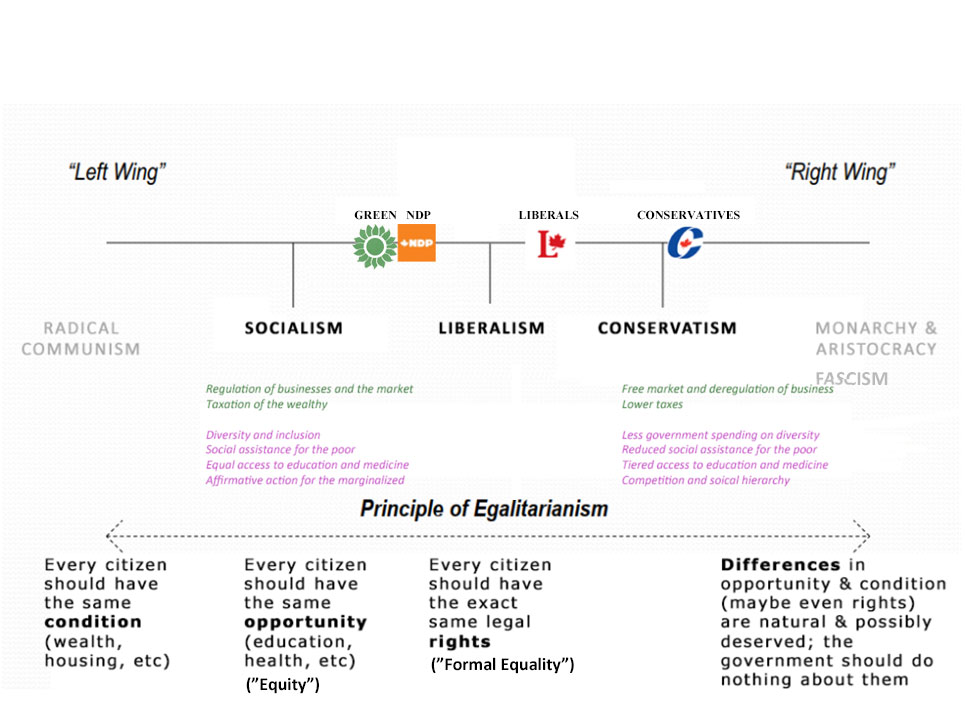
As you can see, the LEFT-RIGHT continuum can be seen as describing a person (or a party)'s philosophy of "egalitarianism" (what they think makes for "equality"; whether they think more equality is reasonable or desirable). At the centre is the liberal baseline, where everyone has exactly the same legal rights.
As you move right toward conservatism, there is more tolerance for inequality, including inequalities that may arise from treating people legally (formally) equal while not taking into account that they are actually not created equal. A white man who is born into a wealthy family with no disabilities is not really likely to be treated equally by current Canadian society or have the same starting point as a disabled indigenous woman who is born poor, to state it bluntly.
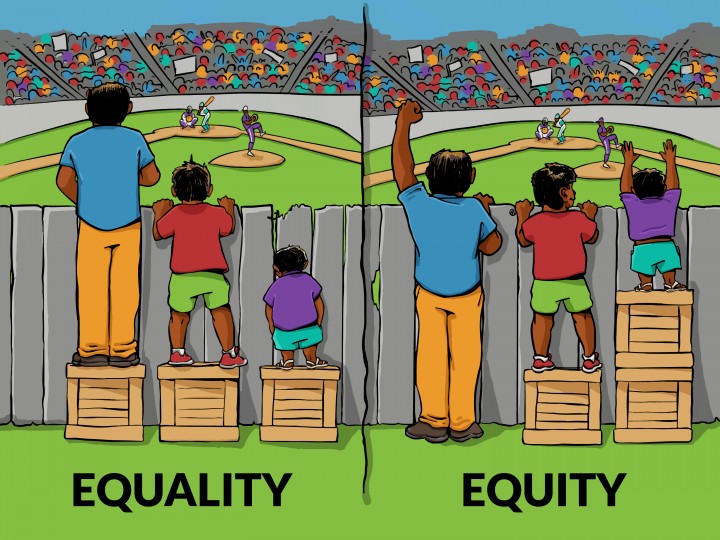
As you move left on the axis you get closer to socialism, which believes in equal opportunity for everyone, and so might endorse free education or medical care for everyone. A centrist liberal might endorse "formal equality" (everyone treated exactly equal by the government) while as you move left people would consider "substantive equality" or "equity" to be a truer way of ensuring real egalitarianism. The difference between the two is often illustrated by people on the left with an image something like this:
The LEFT-RIGHT continuum also awkwardly tends to be identified with the ranges of social conservatism or progressivism of an individual or a party. Thus, when people say they are more "left-wing" this often implies that they are more open to diversity of things like gender and sexual orientation, more in favour of reproductive rights for women, etc. Those on the right are more committed to "traditional" social mores, such as heterosexual norms and so forth.
Those of us who are on the left can be irritated by the fact that those interested in the "fiscal" side of right-wing thinking (lower taxes for all, no government intervention in business or wealth accummulation, and so forth) can also rely on those who are socially conservative for many of their votes. The two are perhaps not necessarily connected. For instance, someone who wants a deregulated free market, tax breaks for the wealthy, and no "hand outs" for the poor could be otherwise socially progressive - Queer Friendly, etc. And someone whose best interests aren't actually in an unbridled economic sector could vote conservative because they are against abortion or gay marriage.
If you did the Vote Compass exercise for this week, this brief test tries to give you a sense of where you might fall on a two-dimensional spectrum (left-right (economic policies) and up-down (social policies)). It also shows you where Ontario's largest polical parties fall. In theory, you might want to vote for the political party that aligns most closely with your own ideology.
Here's what I got last time I did it:
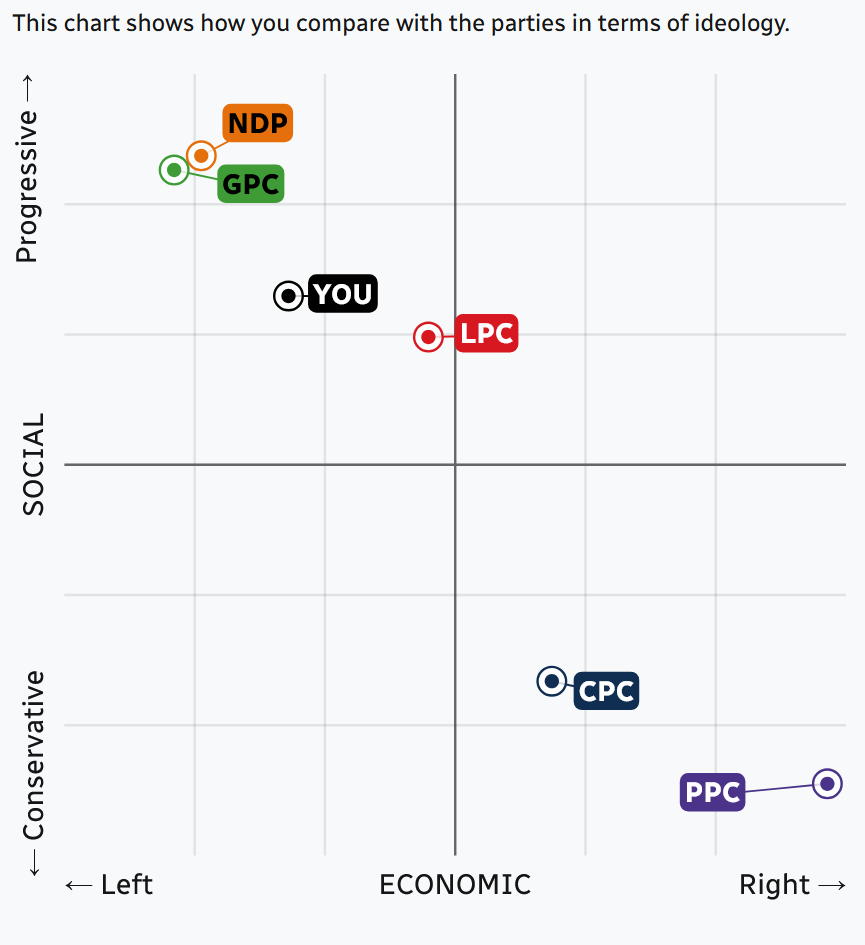
If anything, I was surprised I didn't land further left and further progressive. I have generally voted NDP despite the fact that they don't have a lot of representation in parliament. The NDP candidate would often win in my progressive downtown riding.
Fascism
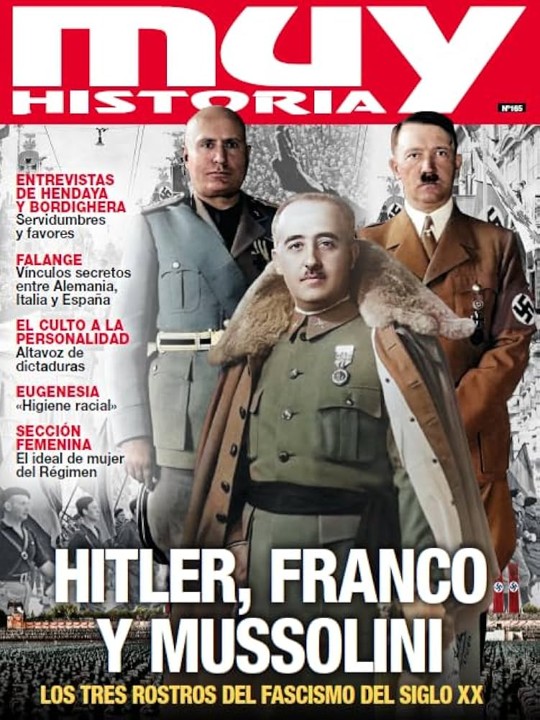
Fascism was a "popular" form of government in Europe in the early 20th century. It is very different from liberal democracy. It is an anti-democratic and ultra-nationalistic ideology, and fascist governments had a single autocratic dictator or party that never changed. Fascism was adopted in three major European nations in the early 20th century: Nazi Germany, Mussolini’s Italy (the origin of the term), and Franco’s Spain. These governments were openly anti-democratic. There was no competition between different political parties with at least somewhat different values, as there is in liberal democracies. A single party decided everything, led by a dictator. The three fascist governments of the early twentieth century were militaristic in appearance and given to flexing.
Both the German and Italian fascist governments had imperialistic agendas: that is, they wanted to expand their territories and create a larger empire. Eventually this led to World War II (1939-1945) with the democratic nations and the communist Soviet Union allied against the imperialist fascist states of Germany and Italy. Spain remained neutral during the war. By the end of the War, Fascist Germany and Fascist Italy had been defeated. Fascist Spain continued until Franco's death 30 years later in 1975.
Here is some footage of Berlin at the time that Hitler was ramping up for a war of conquest (1938). It may give you some sense of what was attractive about fascism, as well as what was terrifying about it.
Power, scale, violence. discipline, stylish uniforms (the Nazis' uniforms were designed by Hugo Boss!). Scholars have made an effort to identify key features of 20th century fascism, largely with the aim of allowing people to watch for signs of what has been assumed by most people to have been a dangerous form of government, at least if world peace and individual freedom are important to you. I will talk about some of these features of fascism below, but I thought it would be interesting to see what the fascists themselves said made their form of government what it was. The term "fascist" originated in Italy and was the name of the party led by Benito Mussolini (1883-1945) . Before World War II, Mussolini laid out his way of thinking in a short essay called "The political and social doctrine of fascism” (1934). I will provide a few excerpts of what Mussolini said, with commentary.
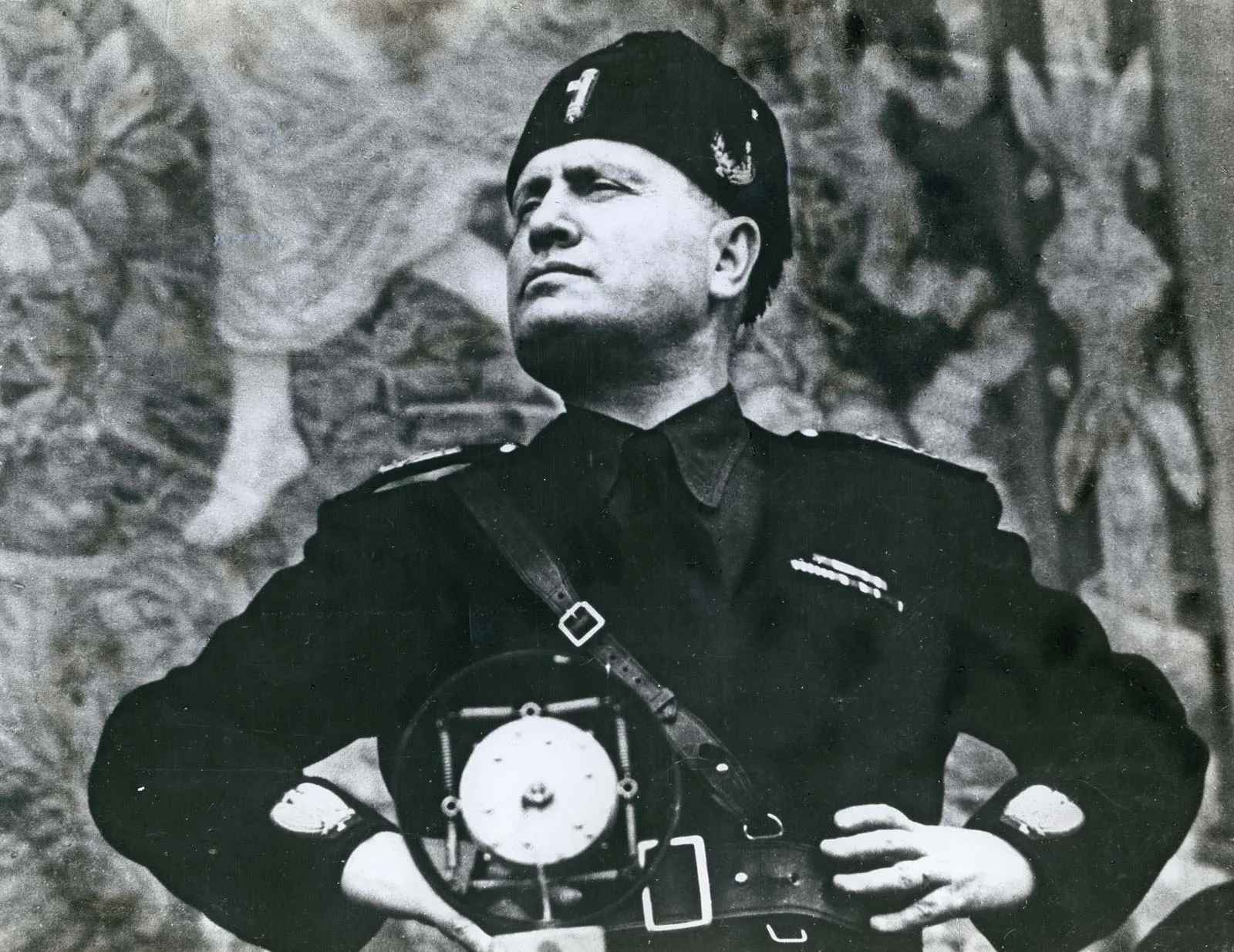
Mussolini defines the movement as pro-war and an opportunity for heroism:
And above all, Fascism, the more it considers and observes the future and the development of humanity quite apart from political considerations of the moment, believes neither in the possibility nor the utility of perpetual peace. It thus repudiates the doctrine of Pacifism - born of a renunciation of the struggle and an act of cowardice in the face of sacrifice. War alone brings up to its highest tension all human energy
and puts the stamp of nobility upon the peoples who have the courage to meet it. All other trials are substitutes, which never really put men into the position where they have to make the great decision - the alternative of life or death.
Fascism is anti-democratic, and against any kind of "majority rule":
Fascism denies that the majority, by the simple fact that it is a majority, can direct human society; it denies that numbers alone can govern by means of a periodical consultation, and it affirms the immutable, beneficial and fruitful inequality of mankind, which can never be permanently levelled through the mere operation of a mechanical process such as universal suffrage.
Inequality is a natural state for human beings, according to Mussolini, and we cannot be made more equal merely through having the universal right to vote. The liberal democracy is committed to each individual, and their personal freedoms and rights. Mussolini suggests that this ideal is outdated and that in the 20th century the time has come for a revolutionary merging of the individual in the collectivity of the State:
... if the nineteenth century [1800s] was a century of individualism (Liberalism always signifying individualism) it may be expected that this will be the century of collectivism, and hence the century of the State. It is a perfectly logical deduction that a new doctrine can utilize all the still vital elements of previous doctrines.
The new fascist state of Italy has an imperialistic agenda; it wants to expand the empire. This is clearly being suggested as a return to the former Italian greatness of the Roman Empire in the ancient world:
For Fascism the growth of Empire, that is to say the expansion of the nation, is an essential manifestation of vitality, and its opposite a sign of decadence. Peoples which are rising, or rising again after a period of decadence, are always imperialist; any renunciation is a sign of decay and of death. Fascism is the doctrine best adapted to represent the tendencies and the aspirations of a people, like the people of Italy, who are rising again after many centuries of abasement and foreign servitude.
Early 20th century fascism generally showed this aspect: a defeated or humiliated or degenerate people were going to rise again and attain new glory.
A number of more recent theorists, historians, and political scientists have tried to analyze and draw attention to the features of 20th century fascism. I will mention some that I find most interesting to watch for today. You will recognize some of these from the excerpts from Mussolini quoted above.
ULTRANATIONALIST
The nation is seen as more important and legitimate than any other nation, or even than any of its individual citizens.
A CULT OF TRADITION
The past is seen as having been greater and now we must rise again to embrace the neglected traditional ideals.
ACTION FOR ACTION'S SAKE; ANALYSIS DELAYS ACTION; DISAGREEMENT IS TREASON
The fascist embraces impulsiveness and distrusts reflection, thought, debate, or analysis
AGAINST DIVERSITY
As Umberto Eco put it in his analysis of fascism: "“The first appeal of a fascist or prematurely fascist movement is an appeal against the intruders. Thus Ur-Fascism is racist by definition.”(Eco 1995) There is usually a widespread assumption that the outsiders are inferior and that they are responsible for our own undeserved difficulties.
RISES OUT OF FRUSTRATION, HUMILIATION, AND ENVY
Often, as with Nazi Germany, fascism is attractive to those who have failed, suffered, or feel they have been cheated of their rightful entitlements. A frustrated middle class powered much of the fascism in early 20th century Europe. This was the case with Nazi Germany, which had suffered greatly after losing World War One, and eventually fell into extreme economic crisis. Hitler convinced the people that their problems came from having been betrayed by their own Jewish citizens (seen as "outside insiders") and by other "impure" factions that had undermined the greatness of German culture and the Nation.
POPULISM
Populism is a political appeal made by a party or leader to the citizens who feel downtrodden or hard done by. It claims that the leader has the interests of "the people" at heart, whereas elites in government and society have betrayed the interests of the people.
PRO-WAR; PACIFISM IS NEVER THE ANSWER
The ideology is flamboyantly militarist and celebrates the unending warfare that is the human condition; death in combat is an heroic ideal.
MACHISMO
The 20th century ideology was extremely masculine-oriented and powered by male bonding around militaristic ideals. Thus it expresses and appeals to ways of being male that we have come to identify as "hypermasculinity" or "toxic masculinity." These include sexism, the readiness to resort to violence, and unreflective entitledness to unearned privilege.
Psychologist Stephen Taylor, the author of The Roots of Human Cruelty and How Connection Can Heal the World (2023), has shown how disconnection from the reality and suffering of other people can play into the fascist mentality. He draws attention to the importance of the Leader (this is what Hitler's title "Der Führer" means). Fascism, he says, is a form of government "not dictated by philosophy but by personality" :
fascism is dictated by the personalities of strongmen, authoritarian leaders. Such figures are usually charismatic, projecting confidence and decisiveness. They are often highly narcissistic, craving adoration and intolerant of criticism. They show psychopathic traits too, mercilessly persecuting their perceived enemies and minority groups. (Taylor 2026)
I wanted to look more closely at fascism because many of my left-leaning sources and friends have used "fascist" to characterize MAGA and the Trump presidency, particularly the use of ICE to crack down on illegal immigrants, the stated desire to expand U.S. territory (Greenland, Canada, Venezuela), the shutting down or defunding of "Woke" education, the appeal to a lost great "tradition," the readiness to replace democratic process with ACTION (the January 6 insurrection), and the faith in a charismatic leader. Rather than drawing further parallels myself, I'll just invite you to consider whether some of the feautures outlined above can be seen to be attractive to Trump's followers and present in the rhetoric used by the President himself.