Introduction to THE FIRST HALF OF GNED 101
Be sure you understand
- How the first half of this class will work and what your responsibilities are
- How the marking will work in the class and the importance of coming to class
- The importance of understanding (as opposed to memorization) in this class
- Why Jim doesn’t upload PowerPoint files
- The whole course will change significantly after Reading Week because it is summer.
Hi

I'm Dr Jim Nielson. I'll be your teacher for the first seven weeks of this elective. I like it when people call me "Dr. Jim" because I used to want to be a DJ, and I try to be a bit of a DJ as a lecturer and a writer of these review essays too.
The challenge of GNED 101 is to learn how to learn better. The keys are paying attention, thinking, asking questions, and being open-minded as you try to understand how someone else is thinking. Each week's topic is coming from a slightly different angle and asking for different skills from you in understanding and thinking about the material.
If you don't like one week's topic, stick around. You may well find the next week's topic of greater interest.
Summertime weirdness
In Summer term, classes get weird. I will only be teaching the first seven weeks of this section of GNED 101. After the midterm and Reading Week, a different prof, Matthew O'Rourke, will be taking over. I encourage you to think of this summertime GNED 101 as two mini-courses of seven weeks each. Matthew and I will each have our own teaching styles, grade schemas, and interests.
Although it's awkward to switch profs halfway through, and is probably not what either Matthew or I would choose (it's a contractual thing to do with time off in summer), I like to think of it as a good exercise for students. The way I see GNED 101, it is a grab bag of interesting topics, but it is also importantly a chance to practice and get better at listening, understanding, thinking, and responding. The additional challenge of two profs will be good for your learning. Matthew may see the course somewhat differently. I don't really know him, but he seems like a nice and very reasonable guy whenever I interact with him.
How marking will work in the first half of this course
When Matthew takes over after Reading Week, he will have his own evaluations and grade scheme. For my half of the semester, I will be experimenting with an unusual plan. It's a little complicated, so please pay attention and ask me if you don't understand something.
We will have five classes before the midterm. In each of these five live classes after the first class there will be a quiz at the beginning or the end of class worth a maximum of 5 marks:
FOUR QUIZZES: 5 marks possible on each.
At the end of the first half you will get to keep the two highest scoring quizzes you did for a maximum of 10 marks.
There will be an in-class exercise for each of the five live classes as well. These will often be worth 5 marks just for doing them.
FIVE EXERCISES: 5 marks possible on each.
Again, at the end of the first half of the semester you will get to keep your two highest exercise marks.
If you miss a class you cannot make up the exercises or quizzes. The purpose is to get you to come to class and engage, and also to avoid me having to read a lot of stuff generated by some chatbot, or plagiarized.
There will be one take-home online exercise worth 10 marks max. You will need to submit that by end of day Wednesday on the week we miss class because of the Victoria Day holiday.
There will be an in-class midterm worth a maximum of 20 marks in week 7.
So, to summarize:
Your best two quizzes: MAX 10 marks
Your best two exercises: MAX 10 marks
Your online reflection piece: MAX 10 marks
Your midterm exam: MAX 20 marks
TOTAL: MAX 50 marks
I repeat. If you miss any of these quizzes or exercises for whatever reason you cannot make it up. This is to encourage you to be in class at least two or three times, lol. And to take notes and study for quizzes and tests, LMAO.
How to succeed in my half of the class
Come to class, pay attention, ask questions, raise issues.
I strongly encourage you to read these review essays I provide as your study method during the first half of the course. You may want to take notes about the topics listed in my sidebars under Be sure you understand at the beginning and end of the review pages.
I also encourage you to try reviving the lost art of taking notes (I know some of you do this).
The early computer scientist Norbert Wiener once wrote: "The human brain evidently operates on some variation of the famous principle enunciated in The Hunting of the Snark: 'What I tell you three times is true.'" (The Hunting of the Snark is a long absurdist fantasy poem, by Lewis Carroll who wrote Alice's Adventures in Wonderland.) What Wiener was saying was that it is a proven principle that if you hear something three times you are likely to remember it. Three is the magic number. You have three options for learning the material in this course.
- Come to class and listen.
- Read the review essays, which are basically written versions of my lectures.
- Study your notes.
Those who want to learn the material in this course fully and remember it accurately will consider doing all three! You will certainly have a better understanding if you both attend class and read these review pages.
What is GNED 101?
This course is intended to be a taster’s menu in General Education elective subjects: philosophy, psychology, sociology, history, politics, and so forth. Each lesson uses an issues-based reading to get you to practice taking in and processing ideas and stories. The course doesn’t have a central theme. It is a series of exercises in understanding and thinking. Each week’s topic is a bit different; the topics are generally focused not around skills or practical methods or memorizing information, but around ideas and scholarly research about how human beings are, why we are like that, and what the challenges are if we want to succeed and be good and be happy, individually and as a species.
The importance of Blackboard
It is very important that you check Blackboard daily and/or have configured it with an email address that you check regularly. I will be communicating with you through Blackboard announcements as well as in class.
Textbook
There is no textbook. Readings are provided for you within each week’s lesson. Generally they are Word docs or PDF files; sometimes web pages. For my experimental first half, I have largely replaced the standard readings with my own lessons. I will be focusing on media. There is only one official GNED reading on media, and it is outdated and terrible. But I also teach an upper level course about technology and media, so I am going to share some of that material with you.
So for this first half (Summer semester being a time for experimentation), I will actually be bringing in material from my other courses. Normally, I start with the official GNED opener, Plato's cave, as many profs do, but this time I am going to jump straight into media history, media theories, and media literacy.
What are GNED electives and why do you have to take them?
GNED stands for General Education. The idea behind these electives is to provide every student with a bit of the kind of liberal arts education they might get at a university, alongside whatever career training they are primarily getting at Humber.
This elective, GNED 101, is intended to help you become acquainted with how GNED electives work and what most other GNED electives will expect of you. The course is also designed to give you a taste of various disciplines and approaches that other electives go into in more detail, for instance psychology, philosophy, history, politics, and the arts. Or as I will be focusing in in the first half this time: cultural studies and media studies.
The Ministry of Education and Humber have traditionally believed these elective courses can help make more well-rounded and responsible individuals and also nurture the kind of critical thinking skills that many employers are actually increasingly asking for. Believe it or not, employers say they want workers who can think outside of the box, learn, adapt, communicate, and above all listen, think and understand. They say they don’t just want robots.
Whether these courses can actually cultivate those abilities remains to be seen, but I don't think they do any harm. Some people love electives (or some of their electives); others are inclined to think they are a meaningless hoop that needs to be jumped through. I encourage you to keep an open mind. I don't like sounding paternalistic at all (it reminds me how old I am and that I am man etc ;-), but there is profound truth in the adage that you will get as much out of this (or any other course) as you put into it. I have put a lot into it. And I generally get a lot out of it.
My lessons come from my own personal perspective, and you aren't expected to agree with that. But you are being tested on your ability to understand the material that I'm presenting. You don't have to agree with it, and disagreement will be productive, but you have to show that you understood the basic ideas, even if you don't always approve of them or agree with them personally.
I encourage you to keep an open mind and also to treat these lessons as exercises in understanding. That's how I teach the course on the whole, and how I will evaluate your work.
In-depth: Why Humber makes students take GNED electives
Various rationales are given for the value of these electives. The first is that employers actually do complain to the Ministry of Education about having a hard time finding people to hire who are capable of paying attention, fully and deeply understanding things, and doing independent critical thinking for themselves. (I was skeptical too. I assumed employers just wanted obedient robots; but I’ve now seen some of the evidence for this new focus on employees who can think critically, and these electives have recently been given a more central place in Humber’s structure.)
Many employers say they appreciate it when their employees have the thinking and communication skills that these electives are designed to promote and help you practice. With offshoring of manufacturing jobs to the developing world and the increasing role of AI and robots in work, there are fewer and fewer well-paid jobs that don’t require an ability to understand complex things, think critically, and communicate effectively with others. Employers favour applicants who show they can understand, think, and think outside of the box when it's called for.
“Squee” Gordon’s desire to give everyone a bit of education
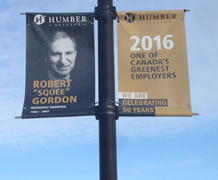 A second argument (one that might never cross your mind) has to do with the kind of thinking that “Squee” Gordon – president of Humber for 25 years – had about education. Like the Ministry of Education, he strongly believed that you deserve to get a bit of an education at college, and not just training. He genuinely thought he was doing something good for you by making these electives part of your diploma.
The argument here revolves around whether the college system has done its job if it has trained you to be an employable cog in the machinery of capitalist labour, or whether it has a responsibility to try to open your minds to other ways of thinking, give you context and some understanding of the history of our current world, expose you to alternative attitudes, etc, and provide you with some language to understand your own values and prejudices more fully and critically.
Someone with values like President Squee Gordon’s might say, for instance, that just because someone didn’t do that well in high school, or just because they are lower class and really need to get a job, or just because they may come from a background culture where broad critical thinking is not encouraged, it doesn’t mean they shouldn’t have access to at least some of the “liberal education” that more privileged people get in their university degrees. Everyone deserves to learn about other ways of thinking, explore their own ways of thinking, and grow in school, not just get “trained.” You may not agree with this view – and there are plenty of arguments that can be made against it – but it is central to the Ministry’s view of college education, Humber’s view, and my own values.
Memorization is not enough in a class like this
But you do need to remember the names, facts, and concepts you're introduced to.
GNED classes are not primarily about learning a specific skill and even less about memorizing meaningless information. This class is about engaging with ideas, understanding them, thinking about them, and having informed and responsible opinions about them, instead of just whatever automatic prejudices or personal interests you may feel.
You will need to remember some facts and words to do well in this class, but memorizing information that is otherwise meaningless to you will not get you very far. You need to “memorize” meaningful information.
In order for information to be meaningful, you need not just to remember it, but to "take it on board" (into your head), understand it, and think about it.
It has to have some meaning and context for you; you need to care about it a little, even.
Your job in this class, then – what you are supposed to be practicing and getting better at – is to do your best to understand the material you are being exposed to - and ask me for help when you can't. Only then can you think critically about it or form valid and accurate understandings and opinions. Therefore, I encourage you to fight against apathy and alienation in your attitude toward the class. You will find that the more attention you pay, the more meaningful the ideas will become and the more you can care about them, while the less you pay attention and care about them, the more meaningless (and incomprehensible) they will seem. In my experience, this is true in life generally. ,-)
PowerPoint does not empower learning
 I don’t upload my PowerPoint slides for any of the courses I teach. Instead I make students read something like this. Critics have begun attacking PowerPoint because, as one article’s title put it, “It makes students stupid and professors boring.” (This was in Business Insider, just in case you immediately assume that it was in some hippie Liberal Arts newsletter or something!)
PowerPoint, I suggest, has many shortcomings when it comes to genuine learning. PowerPoint
- Gives you key words or phrases that are meaningless without context and understanding.
- Distracts from listening and thinking.
- Doesn’t represent logical connections well.
- Is only as reliable as the person who made it.
I use PowerPoint in class mostly as reminders of what I want to say and multimedia delivery systems for things that I want to show you or have you hear.
I believe that you cannot learn anything in this class from memorizing PowerPoint bullets. Instead, I expect you to read stuff like this, listen and talk in class, pay attention, understand, ask questions, learn. When I am evaluating you I am assessing your learning.
Although things seem to have been changing, when I first started teaching here in 2010, it felt like many people were making it a point of honour to get through every class learning as little as possible. If you've taken that approach yourself in school (and there are lots of perfectly understandable reasons why people may do that), that attitude to learning will be tested here!
Verbum sat. (Look it up.)